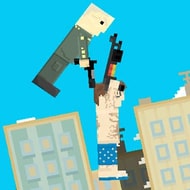
Getaway Shootout looks like a simple race to a getaway vehicle. It plays like two ragdolls flailing across a map, tripping over their own momentum, and somehow still making it to the finish line half a second ahead of everyone else.
Getaway Shootout: A Race Dressed Up as a Fight
The actual objective in every round is reaching the escape vehicle before your opponents do — a car, a plane, whatever the map ends on. Everything else that happens along the way, the punches, the weapons, the money bags scattered across the level, exists to slow other players down or speed yourself up. It’s easy to play it like a straight brawler at first, and just as easy to lose that way, because the player who ignores every fight and sprints for the vehicle sometimes wins outright.
The controls are deliberately loose. Characters stumble, overcorrect, and occasionally faceplant from their own jump, and that physics-driven clumsiness is the entire personality of the game. A clean punch connecting exactly when you meant it to feels earned specifically because the movement fights you the rest of the time.
Maps end differently depending on the round, and reading which vehicle you’re actually racing toward changes how you should be moving from the very first second — a plane spawn favors a different route than a car parked at ground level, and assuming the escape point without checking costs precious time.
Getaway Shootout’s Weapons, Money, and Fights
Money bags scattered across each map matter because collecting enough of them unlocks new characters and options, which gives even a loss some long-term value. Weapons picked up mid-level — anything from melee swings to ranged options — can knock an opponent down long enough to steal their lead, but stopping to fight also costs time you could have spent just running.
Terrain matters just as much as anything you’re carrying. Narrow platforms and edges turn an ordinary punch into a potential ring-out, and players who understand the map’s hazards tend to win fights by positioning rather than by landing more hits.
- Grabbing a weapon early can control the pace of an entire round if you use it to punish whoever’s in front.
- Ignoring pickups and sprinting straight for the vehicle is a legitimate strategy on maps with a short, direct path.
- Getting knocked off a ledge or into hazards costs far more time than losing a fistfight ever does.
None of these choices exist in isolation — grabbing a weapon costs the seconds an opponent spends closing the distance without one, and that trade-off is exactly why a map’s layout matters as much as any individual pickup on it.
Duels, Group Rounds, and Reading the Map
Matches can be played as straight one-on-one duels or scaled up with more players scrambling for the same exit, and the right approach changes with the format. In a duel, fighting for map control near the vehicle spawn often matters more than winning early skirmishes. In a crowded round, staying alive and moving is frequently safer than picking a fight you don’t need.
What New Players Get Wrong
The instinct to fight every opponent you pass is the single biggest reason new players lose rounds they were otherwise winning. Time spent trading punches near the middle of a map is time an opponent who kept moving used to reach the vehicle first.
Why the Physics Get Debated
The floppy, unpredictable movement is exactly what fans point to as the game’s identity, and it’s also the most common complaint — a badly timed stumble at the worst possible moment can lose a round that had nothing to do with skill. Whether that’s charming chaos or frustrating randomness depends entirely on who you ask.
What Players Ask Before Their First Race
- Is Getaway Shootout about fighting or about racing to the vehicle? Racing is the actual win condition — fighting and weapons are tools to slow opponents down, not the goal itself.
- Why do the controls feel so clumsy? The stumbling, ragdoll-style movement is intentional, and learning to work with it rather than fight it is a core part of getting better at the game.
- What are the money bags actually for? Collecting them unlocks new characters and options over time, so even a round you lose can still be worth playing out fully.
Getaway Shootout works precisely because it never lets you fully trust your own footing, and the players who do best are the ones who stop treating every stumble as a disaster and start using the chaos against everyone else on the map. Whether you fight your way to the vehicle or just sprint past the whole mess, the finish line only cares who gets there first.